Saturday, August 7, 2021

Brand New Day

It's been almost 6 years since my last post here. A lot has happened: a 2-week training on a tall ship; a new job; a half marathon; a promotion; taking up a new language (Duolingo streak 1311 days and counting); a second home that was going to become a primary residence; a pandemic (that's still ongoing); a leave of absence to help care for an ailing parent in Taiwan (in the middle of the pandemic); a series of wildfires that destroyed that second home; a mad dash to find trees and government assistance after the wildfires; a long journey to seek insurance reimbursements; an effort to start (re)building the future home. And yet, I am thankful that my husband and I are in relatively good health and have each other.

Those all sound like good excuses for slacking in writing, but the main reason actually has to do with the role I'm in these days. As the Vendor Manager of a prominent LSP in the US, I don't want my words to be taken as representative of LanguageLine or vice versa. I know that some vendors wishing to work with LanguageLine actually try to connect via this blog, and that's not really what this venue is for.

A lot has changed in the translation and localization industry in the past 6 years. Machine Translation isn't the laughing stock that it used to be, thanks to innovations in technologies. Depending on what the need for translation is, sometimes MT outputs are actually enough for comprehension purposes. Human translation still has its place (and won't be replaced by MT any time soon - yet), but we now also have "human in the loop" to help bridge the gap and get translations done faster.

The pandemic didn't slow things down. It accelerated the growth of this industry, in fact. Translators are used to working from home, therefore being in lockdown does not necessarily mean having no work. The need to get the latest information out to the public also contributes to this invigorating growth. Translators in general are still paid peanuts, but at least they're getting lots and lots of peanuts.

Distance learning and online meetings make the need to transcribe/translate recorded content go up exponentially. And then Zoom announced its acquisition of Kites, so they can start providing multi-language translation capabilities for Zoom users. How genius was that?!

All in all, lots of encouraging stuff is happening. Sitting in a front-row seat, I eagerly await what comes next.


Please translate responsibly.

Friday, August 28, 2015

Signs Spotted in Taiwan

My family and I came across some signs with bad translations while staying in Taiwan for three weeks recently.  These are only a small portion of what we saw, mainly because there wasn't always time to take a picture whenever such an example presented itself.  

  • (My hiking companion feigned a double take and asked what was so attractive about this trail.) A better translation for the sign below would be:
    行人小心 = Caution

    路滑崎嶇 = The trail is slippery and rough
Apologies for the blurry image. The English on the sign reads: Be careful. The road is rugged.


  • I'm not sure why, but quite a few steak places in Kenting (墾丁), Taiwan, omit the "k" on their signs. 
Where's the "k" in "steak"???


  • "本停車場僅供房客停車使用,不負保管責任。" can be easily translated as:
    "Parking lot for use of guests at Château Beach Resort only. Not responsible for theft or damage to vehicles or contents."


    As for the "Kindly to Notice" part, it's possible they meant to say "A Friendly Reminder" or something to that effect.
Found in the parking lot of a beach resort hotel in Kenting, Taiwan.


  • An interesting phenomenon in Taiwan is the promotion of healthy living.  I also saw signs about exercise, personal fitness, weight control, and healthy diet in a government office building -- in a stairwell.  The mistranslations on the sign below merit a separate post.  Right now I'm just pointing out a few obvious ones on the left of the sign:
    • "Interesting Sport Physiology" (有趣的運動生理) should be "Interesting Sports Physiology".
    • "Slender Stature"(苗條身材) should be "Slender Figure".
    • "Watch in sequence"(看本圖的順序) refers to how one should use the diagram to calculate calories used, starting with their pace in the lower left quadrant and going counterclockwise.  Therefore, a better translation would be "To use this diagram".
This sign (titled: 有趣的運動生理) was inside a national park.


There will be a separate post to further dissect this big sign.  Stay tuned. 


Please translate responsibly.

Friday, July 10, 2015

Subjects Matter

The practice of hiring translators located in their native countries may not be the best way to get the job done.

Before anyone gets offended by that statement, please let me make it perfectly clear that I'm not proposing to use non-native speakers to translate.  Nor am I suggesting that only expats are qualified translators.  It's just that some subjects are better handled by translators who have actually lived a long time in the environment where the source language is used.

Yes, subjects do matter.  And it's a project manager's job to know who should handle what assignment.  For a project manager that works in a big company, hopefully his or her account manager knows that distinction as well.  It's always a sad situation when there's not enough budget to work with because a decision maker underestimated the tasks involved.

Let's take U.S. English > Simplified Chinese translation as an example.  For most cases, hiring a translator in China is an obvious choice: their rates are much lower than what we find in the U.S., and they're native Chinese speakers that use Simplified Chinese on a daily basis.  So why not use someone in China to translate everything?

The biggest reason, I would say, is because there are things you can't learn thousands of miles away.  Translations about computers, software, patents, medicine, science, etc. may be done by someone in China with no ill effect.  But daily topics and life subjects in general are a different level of tricky.

I've seen translations where "the weave" (for one's hair) was translated as "织物" (knitted or woven things) and "spotting for someone" (as in workout) became "从背后偷窥" (peeking at someone behind their back).  And when a speaker in a film talks about "the Michigan State" as in the state penitentiary system, it was translated as "密歇根州" (the state of Michigan).  These distinctions are trivial for a native English speaker to pick up on, but to a non-native speaker who doesn't live the language, it may as well be Greek.  For subject matters like these, if you must use someone in China for budgetary reasons, the very least you should do is hire a good reviewer located in the U.S. to QA the translation before it gets handed off to desktop publishing or voice over work.

A stitch in time saves nine.  You don't want to have to re-do the voice over or printing, do you?


Please translate responsibly.

Wednesday, June 10, 2015

About Machine Translation

To keep myself informed of the industry I work with, I subscribe to quite a few translation and localization groups on LinkedIn.  Every so often, someone posts something that resonates with group members so much that people write comments to continue the discussion, even after the original inquiry has been answered satisfactorily.

One recent example was about machine translation.  Not surprisingly, many translators denounce machine translation and refuse to work with it in any shape or form.  And with good reason: there are unscrupulous agencies out there asking linguists to post-edit machine translations for a pittance, sometimes at rates even lower than proofreading.

As I mentioned before, with low-context languages, machine translation is actually doing an adequate job for the most part.  But to make a low-context language's machine translation up to snuff takes more than proofreading skills, and should be compensated accordingly.  Any agency equating MT post-editing with mindless work has no respect for this industry or profession, and deserves to be avoided at all costs.

That being said, I'd like to offer my own perspective on machine translation.  A few years ago, I really despised it.  Look at Google Translate when it came out: what a joke that was!  I had no faith in machine translation, and said so to any agencies that asked for my opinion on the matter.

Now that I have worked with machine translation personally, I can honestly say that it does have a place in this industry.  One shouldn't depend on machine translation completely, of course.  But the convenience it provides is well appreciated by many.  Depending on the subject matter and whether it's translating low-context or high-context languages, some machine translation actually can produce usable results.

I haven't been converted yet.  But I do think linguistic professionals shouldn't turn up their noses at the mention of "machine translation" alone.  If the compensation is reasonable, take the plunge and add a feather in your cap.  In my experience, the machine really is an ally worth knowing.  


Please translate responsibly.

Saturday, May 23, 2015

The Thing About Character-Based Languages

This was spotted in Taiwan and then posted on FaceBook recently:  


A perfect example of someone using Google Translate without verifying the accuracy of machine translation, it caused enough of an uproar that a local newspaper took a jab at the sign as well. 

The following statements are all true:

報 = newspaper
到處 = everywhere
報到 = to report (for duty)
處 = location
報到處 = sign-in counter

The thing about character-based languages is, meanings mostly derive from phrases formed by two or more characters.  It's a game of memorization, therefore experience plays a big part in these languages.  Without enough data, a non-native speaker (or a machine, as demonstrated by the picture above) doesn't know how to parse a phrase to get the correct meaning: is it [報到]+[處] or [報]+[到處]?

As we find out, the machine guessed wrong this time.  But the sad thing is nobody caught it before it got printed out for the whole world to see.

While we're on the subject, the newspaper report mentioned above also contains errors.  This is what they said:
依據國家教育研究院機關雙語詞彙建議規定,中文的「報到處」正式英文翻譯應用「Checking Counter」、「Registration」用「Newspaper Everywhere」是錯誤的用法。
This is how it should be written:
依據國家教育研究院機關雙語詞彙建議規定,中文的「報到處」正式英文翻譯應用「Check-in Counter」、「Registration」。用「Newspaper Everywhere」是錯誤的用法。
 
Whether "Registration" applies is debatable; it depends on what kind of 報到處 the place is.


Please translate responsibly.

Image source: Liberty Times Net.

Tuesday, May 5, 2015

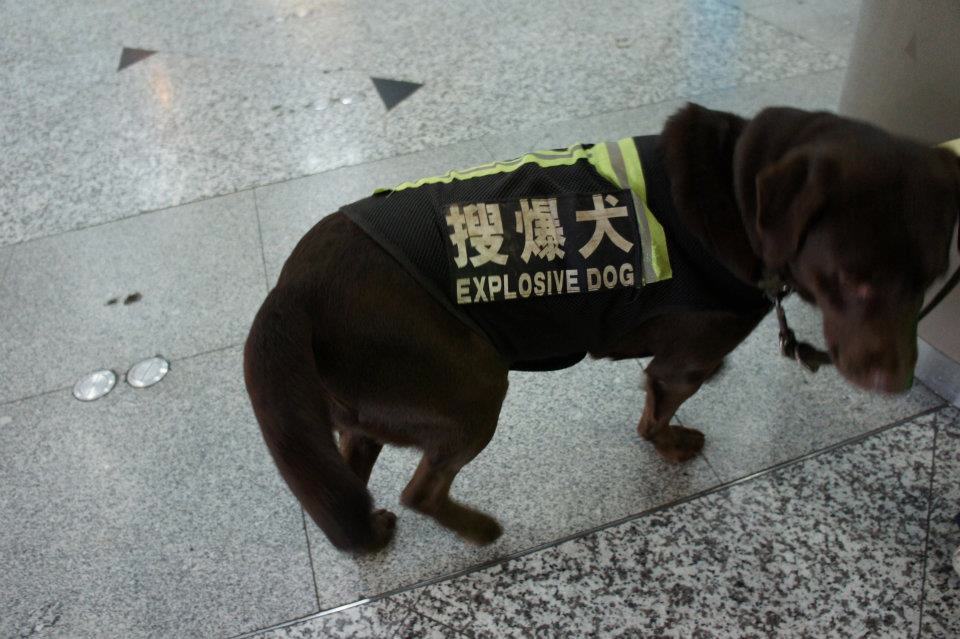
Funny Translation of the Day

I thought I'd share this image that someone sent me today:

An "explosive dog" is "a dog that is explosive".   Translated into Chinese, it'd be 爆发犬 (or 爆發犬 for Traditional Chinese).

The correct English for 搜爆犬 should be "explosives dog" or "explosive detection dog."


Please translate responsibly.

Image credit: Pleated Jeans.

Sunday, April 19, 2015

The Skinny on the Languages in Taiwan

Quick question: what's the official language (written and spoken) in Taiwan?

If you don't know much about this island, chances are your answer would be "Taiwanese."  

And you would have guessed wrong. 

For the sake of brevity, I won't go into details about the history or politics of Taiwan vs. China.  What I'm going to attempt here is to address some general (but totally understandable) misconceptions some people may have about Taiwan, and other trivia on the languages used there.


  1. Mandarin is the official language spoken in Taiwan, written in Traditional Chinese characters.
  2. The "Taiwanese" language in Taiwan refers to a variant of the Fujian dialect.  It wasn't until about 10 years ago that the government in Taiwan realized the importance of revitalizing this second-most spoken language on the island.  The written form of "Taiwanese" is still in development and therefore not widely applied like the way Cantonese is.
  3. The third-most spoken language in Taiwan is the Hakka language, which shares some similarities with Cantonese.
  4. There are a dozen or so indigenous languages in Taiwan spoken by the Taiwanese aborigines.  Faced with the danger of extinction, quite a few of these languages are undergoing a revival similar to that of the Taiwanese language, with varying degrees of success in their progresses.
  5. This has nothing to do with the languages in Taiwan, but is worth mentioning because of the confusion so many have had: Taiwan≠Thailand.


Please translate responsibly.

Monday, March 30, 2015

Traits of a Good Linguistic Professional

After I stepped into the project management side of the translation/localization industry, it came as a mild shock to find that few linguists read instructions and how few are comfortable using the various CAT tools out there. In fact, every time I talk to a project manager within the industry, I get a knowing chuckle when I tell them "this linguist is one of those that actually read all the instructions."  

As a linguist, I always want to know how a client thinks of my performance.  As a project manager, I get asked quite often by linguists who want to know how well they've done their jobs.  Having the advantage of being on both sides of the process, I've decided to share with fellow linguists what their clients look for in a linguistic professional.

  1. Always read instructions - The client gives written instructions because it's the only way to ensure everyone is on the same page about what's expected.  And of course you should follow the instructions unless you need to...
  2. Ask questions when instructions don't make sense - As humans, we're known to make mistakes.  If something in the instructions doesn't make sense, be sure to ask for clarification.
  3. Be responsive and flexible - When a linguist is cheerful and accommodating in his/her availability, it invariably opens a lot of doors for future opportunities. 
  4. Have excellent time-management skills - Like I've said before, many things often come down to the wire in this industry.  Failing to plan is planning to fail.
  5. Be unafraid to use new software - A good linguist isn’t afraid to use a new CAT program, digging in on their own to learn how it works; to "boldly go where no one has gone before."  I've seen many a good linguist falter when asked to use some software for the very first time.  For this group I'd like to offer some encouraging news: CAT tools are made for translators and linguistic professionals, not for software engineers.  As such, they are actually very similar and quite user-friendly.  If you've used one of them, chances are you will be able to figure out the rest without too much difficulty.  
  6. Know your limits - Most linguistic professionals are eager to please and tend to say Yes to everything.  From a growth mindset, this is definitely the way to develop yourself into a well-rounded linguist.  However, it is perfectly okay to turn down an assignment if you feel you won't be able to deliver because you don't have enough time or subject matter expertise. Be frank with your client if you have serious reservations about taking on a task.  More often than not, the client will thank you for the candor because it gives them time to place the assignment elsewhere.
  7. Can out-Google the best of 'em - How is your Google-fu?  If a rush translation job about an oil transportation contract lands in your lap, do you have the research chops to get up to speed on the subject matter so you can deliver quality work?
 
This industry, which is not known for compensating its individual contributors handsomely, sure asks a lot of these same contributors.  But it does have some rewarding moments.  It is my belief, though, that good linguists will shine through and be kept busy by their appreciative clients.


Please translate responsibly.

Sunday, March 8, 2015

Ham Hocks vs. Sexual Harassment

.

A reader sent me this picture and asked, "What does the Chinese say?"

Sitting at home, I burst out laughing.  For this case not only shows a lack of understanding of the languages from both the content writer and the translator, but also demonstrates the breakdown of communication between these two key players.

First, let us dissect the Chinese on the placard:

德式 = German style
咸 = salted; salty; cured
猪手 = ham hock(s)

However, in many parts of the Chinese-speaking world, 咸猪手 is slang for "grabby hands."  Therefore, whoever decided to name this dish 咸猪手 was either careless or completely unaware of its "grabby hands" annotation.  Seeing that the translator didn't raise the red flag that the use of 咸猪手 was questionable, it is very likely that most people in 长沙 (where Quan Sheng Hotel is located) are not familiar with this particular "grabby hands" slang.

It is plausible that the person tasked with translating  德式咸猪手 into English used machine translation such as Google Translate for the job, but didn't bother to check what "German type sexual harassment" actually means in Chinese.  For if they had taken the time to do a back translation of "German type sexual harassment" they would've found that this would by no means refer to a dish.

So, how does one say "Cured Ham Hocks" in Chinese?  咸猪脚 and 咸猪蹄 are both fine choices, but definitely not 咸猪手.

And the placard should've read:


德式咸猪脚
German Style Cured Ham Hocks

Or, if 猪手 absolutely has to be used because that's the way the locals say "ham hocks" in Chinese, then the placard could read:


德式猪手
German Style Ham Hocks


Please translate responsibly.  
 
Image credit: Imgur

Thursday, February 26, 2015

Warning on a Remote Control Helicopter


WARNING
If blade damage,don't be fly. otherwise it will create the human body or blame damage. 

The warning above is found on an RC helicopter that our family treated ourselves to for Christmas 2013.  I don't know about you, but this is what came to mind when I saw it:

Did they use Google Translate to come up with that?

To test the theory, I used Google Translate to do a back translation of the message and got this:

如果叶片损坏,不要飞。否则会造成人体或怪的伤害。 -- Believe it or not, that's actually close to 100% accurate in terms of what the warning probably would be.  

And if we put the Chinese back translation into Google Translate to see what the English would say this time, we get:

If the blade is damaged, do not fly. Otherwise it will cause harm to humans or strange.  -- Again, it's almost 100% accurate.  So, good news -- they probably didn't use Google Translate!

I'm guessing the Chinese original is something like 如果叶片损坏,不要飞。否则会造成人身或责任伤害。

Which should be translated as: Do not fly the helicopter if a blade is damaged, otherwise bodily injury or property damage may occur.

And here's a message for the manufacturer of a nifty helicopter: 您的直升机翼上面的英文说的是:“如果叶片损坏,别当苍蝇。否则将创造出人体或责怪伤害。”


Please translate responsibly.

Wednesday, February 18, 2015

Online Tools for Chinese/English Linguists or Learners

There is a saying in Chinese: 工欲善其事,必先利其器。Literally translated, it means if a worker wishes to do a good job, he must first sharpen his tools.

Below is a list of online dictionaries and linguistic tools that I have found useful over the years.  I'm opening my tool box in the hopes that others will benefit from these websites.  Most of them focus on Chinese/English or Simplified/Traditional Chinese, therefore general reference tools such as Merriam-Webster Dictionary and the OED are not included.


Needless to say, these tools aren't 100% foolproof all the time.  Depending on the nature of the project one works on, one may have to look for other resources as well.  But the list is a good start, I hope, for anyone that wishes to improve on their understanding from either direction of the language pair.  


Please translate responsibly.

Thursday, February 12, 2015

Language - Where Many Wrongs Can Become a Right

Language is a living thing.  It constantly evolves and grows with the people who use it on a daily basis.  Humans are not machines, though, therefore mispronunciations and typos are common occurrences.  We even say things that are grammatically incorrect from time to time.  One can find examples in pretty much every language in the world:

mischievous vs. mischievious 
换档 vs. 换挡

In both cases above, the phrase in bold is the correct form, but people use the latter form so much that it's become acceptable.  Dictionaries list the latter as a variant of the correct form, meaning it is non-standard but in use and accepted.  

Mistakes like those used to be easy to contain.  These days, however, technology has actually contributed to the spreading of these errors.  With the aid of new phrase learning, search suggestions, and autocomplete, a seemingly innocuous typo can earn itself a spot on the top search results in a matter of days.

So, what should people who work with words do?  

Recently I was involved in a large-scale localization project, not as a translator but as quality assurance at the final stage.  I was surprised to find that "gear" (as in transmission) had been translated as both 挡 and 档 in the glossary, which was already approved and couldn't be modified by then.  I looked them both up and yes, in Simplified Chinese it has become acceptable to use terms such as 换挡 or 手排挡.  Even though the correct phrases are 换档 and 手排档, respectively.  

Interestingly enough, in Traditional Chinese 檔 and 擋 are not interchangeable in any phrases.  And for good reason: the 木 radical in the former indicates that the word 檔 is most likely a noun, whereas the 扌 radical in the latter suggests that 擋 is most likely a verb.  Therefore, a student in Taiwan writing either 換擋 or 手排擋 will be marked as wrong.

I'm not going to say one system is better than the other.  Depending on a person's perspective, I'm sure the answer can be quite different.  One can say, for example, that Simplified Chinese is more forgiving.  Or, another can argue, that it is making people sloppier.

From the standpoint of quality, however, I think the translators should at the very least be consistent.  If you like to use the variant 挡, that's fine; but please do it across the board.  However, considering that 挡 is still non-standard, I'd suggest one stick with the correct form of 档 and stop the errors from spreading even further.


Please translate responsibly.

Wednesday, December 10, 2014

About Back Translation

Translators get all kinds of request.  Most of the time it's just a straight-up translation job.  But once in a while, a client will ask a translator to provide a "back translation" for some existing translation.

What is that, you ask?  Simply put, a back translation is the translation of a translation back into the source language.  For example, someone translated an English document into Japanese.  Then, the client who ordered the Japanese translation asks someone else to translate the Japanese document back into English.  That's called a back translation.

In fact, if you've ever asked Google Translate to translate a phrase, and then switch the translation direction just to see what Google Translate says it means in the source language, you've already had Google Translate do a back translation for you.

Here are some examples from Google Translate, in the order of source/translation/back translation:

back translation/回譯/Back translation
一触即发/On the verge/濒临
epic fail/史诗般的失败/Epic fail

You may wonder why someone would go through all that trouble to have something translated back and forth.  (It certainly isn't for kicks, like the Google Translate scenario above.)  The short answer is for quality assurance.  A back translation will help the client figure out whether the first translation faithfully conveys the meaning and flavor of the source material.  This is especially important if the content has to do with advertising or customer service, where the human factor plays a key role.  A sample back translation can serve as a "spot check" of the entire document.

In the QA phase of localization, back translation helps QA leads, managers, and engineers (most of whom may not know this particular language) judge the severity of a linguistic issue.  Oftentimes the tester is asked to back translate the questionable localized text into the source language (and suggest a suitable translation), so a team leader can decide if a new translation is needed.

Of course, sometimes a client asks for a back translation because the quality of the first translation is in question.  However, this kind of practice is rare, since most translators are pretty conscientious about the quality of their work.  Moreover, many clients have their own gatekeepers to weed out bad translations way in advance to avoid this altogether.


Please translate responsibly.

Thursday, November 27, 2014

There Are No Bad Translators

A dear friend of mine is a veteran in the publishing industry in Taiwan.  Something she and her colleagues said has stuck with me after all these years:

"There are no bad translators, only lazy ones."

In this day and age, I think that's pretty much 100% true.  As far as accuracy is concerned, a translator really has no excuse for getting anything wrong.  Whatever we don't know or aren't sure of, we can look it up online and find answers immediately.   If you do your research, you will be able to deliver accurate translations.

As for having the translation maintain the style and flavor of the original, that's something one has to work at.  And yes, there are some translators who do this better than others.  But it's not unattainable.  Again, it can be done by anyone willing to put in the hours.

Thomas Edison famously said all his work "boils down to one percent inspiration and ninety-nine percent perspiration."  The same holds true for translation.  Even the most talented translators have to "work" to translate anything; those words don't translate themselves!

For translators and anyone working in this industry, good time management is especially vital because things often come down to the wire.  Failing to plan is planning to fail.   

Speaking of which, it baffles me to see people procrastinate on jobs that they've never done before.  How would anyone know what kind of time they'd need for something they're doing for the first time?  Wouldn't it be wise to start as soon as possible so we'd have more time for unforeseeable bumps down the road?  It's a simple "the tortoise and the hare" situation, but the inertia is such that we still get too cocky to just "get up and go."


Please translate responsibly.

Monday, November 17, 2014

"English" Slang in Other Languages

As the de facto international language, English has been welcomed and incorporated into languages and cultures around the world.  Many countries start teaching kids English as early as when they enter elementary schools.  Therefore, perhaps it's inevitable that many languages have developed their own "English" phrases.

At first blush, they appear to be English.  But to a native English speaker, they are not only grammatically incorrect most of the time, but also confusing as all get-out.  Why?  Because these "English" versions grew out of completely different cultural and linguistic backgrounds and, therefore, can only be understood in the correct context.

Here are a couple of examples:


Jetso being ing lah!
Own car repair fu good man! 

What do those "English" words actually mean?
1. Jetso - the romanized pronunciation of Cantonese 著數, which refers to some special offer or discount.
2. ing - a borrowed form of the progressive tense, referring to any activity or action that is going on right now.
3. lah - a popular, albeit neutral and somewhat meaningless, sentence-ender in Chinese. 
4. man - adjective; the equivalent of "manly."
5. fu - noun; the equivalent of "feeling" or "impression."

So those two sentences can be translated as:
Special Offer Going On Right Now!
Fixing your own car feels so manly!

I can't speak about other languages, but I'm guessing they have something similar as well.  If a word can't be found in an English dictionary, at least we'll know it's made up.  But a word like "man" in the example above can be pretty confusing.  The only way to learn what they mean and how they're used is if you live them, i.e. in context or through immersion.  

And I dare say, as the Internet furthers its reach, this type of slang will only grow exponentially.  

Welcome to the digital age!


Please translate responsibly.