To keep myself informed of the industry I work with, I subscribe to quite a few translation and localization groups on LinkedIn. Every so often, someone posts something that resonates with group members so much that people write comments to continue the discussion, even after the original inquiry has been answered satisfactorily.
One recent example was about machine translation. Not surprisingly, many translators denounce machine translation and refuse to work with it in any shape or form. And with good reason: there are unscrupulous agencies out there asking linguists to post-edit machine translations for a pittance, sometimes at rates even lower than proofreading.
As I mentioned before, with low-context languages, machine translation is actually doing an adequate job for the most part. But to make a low-context language's machine translation up to snuff takes more than proofreading skills, and should be compensated accordingly. Any agency equating MT post-editing with mindless work has no respect for this industry or profession, and deserves to be avoided at all costs.
That being said, I'd like to offer my own perspective on machine translation. A few years ago, I really despised it. Look at Google Translate when it came out: what a joke that was! I had no faith in machine translation, and said so to any agencies that asked for my opinion on the matter.
Now that I have worked with machine translation personally, I can honestly say that it does have a place in this industry. One shouldn't depend on machine translation completely, of course. But the convenience it provides is well appreciated by many. Depending on the subject matter and whether it's translating low-context or high-context languages, some machine translation actually can produce usable results.
I haven't been converted yet. But I do think linguistic professionals shouldn't turn up their noses at the mention of "machine translation" alone. If the compensation is reasonable, take the plunge and add a feather in your cap. In my experience, the machine really is an ally worth knowing.
Please translate responsibly.
Wednesday, June 10, 2015

Saturday, May 23, 2015
The Thing About Character-Based Languages
This was spotted in Taiwan and then posted on FaceBook recently:

A perfect example of someone using Google Translate without verifying the accuracy of machine translation, it caused enough of an uproar that a local newspaper took a jab at the sign as well.
The following statements are all true:
The thing about character-based languages is, meanings mostly derive from phrases formed by two or more characters. It's a game of memorization, therefore experience plays a big part in these languages. Without enough data, a non-native speaker (or a machine, as demonstrated by the picture above) doesn't know how to parse a phrase to get the correct meaning: is it [報到]+[處] or [報]+[到處]?
As we find out, the machine guessed wrong this time. But the sad thing is nobody caught it before it got printed out for the whole world to see.
While we're on the subject, the newspaper report mentioned above also contains errors. This is what they said:
Whether "Registration" applies is debatable; it depends on what kind of 報到處 the place is.
Please translate responsibly.
Image source: Liberty Times Net.

A perfect example of someone using Google Translate without verifying the accuracy of machine translation, it caused enough of an uproar that a local newspaper took a jab at the sign as well.
The following statements are all true:
報 = newspaper
到處 = everywhere
報到 = to report (for duty)
處 = location
報到處 = sign-in counter
The thing about character-based languages is, meanings mostly derive from phrases formed by two or more characters. It's a game of memorization, therefore experience plays a big part in these languages. Without enough data, a non-native speaker (or a machine, as demonstrated by the picture above) doesn't know how to parse a phrase to get the correct meaning: is it [報到]+[處] or [報]+[到處]?
As we find out, the machine guessed wrong this time. But the sad thing is nobody caught it before it got printed out for the whole world to see.
While we're on the subject, the newspaper report mentioned above also contains errors. This is what they said:
依據國家教育研究院機關雙語詞彙建議規定,中文的「報到處」正式英文翻譯應用「Checking Counter」、「Registration」用「Newspaper Everywhere」是錯誤的用法。This is how it should be written:
依據國家教育研究院機關雙語詞彙建議規定,中文的「報到處」正式英文翻譯應用「Check-in Counter」、「Registration」。用「Newspaper Everywhere」是錯誤的用法。
Whether "Registration" applies is debatable; it depends on what kind of 報到處 the place is.
Please translate responsibly.
Image source: Liberty Times Net.
Tuesday, May 5, 2015
Funny Translation of the Day
I thought I'd share this image that someone sent me today:

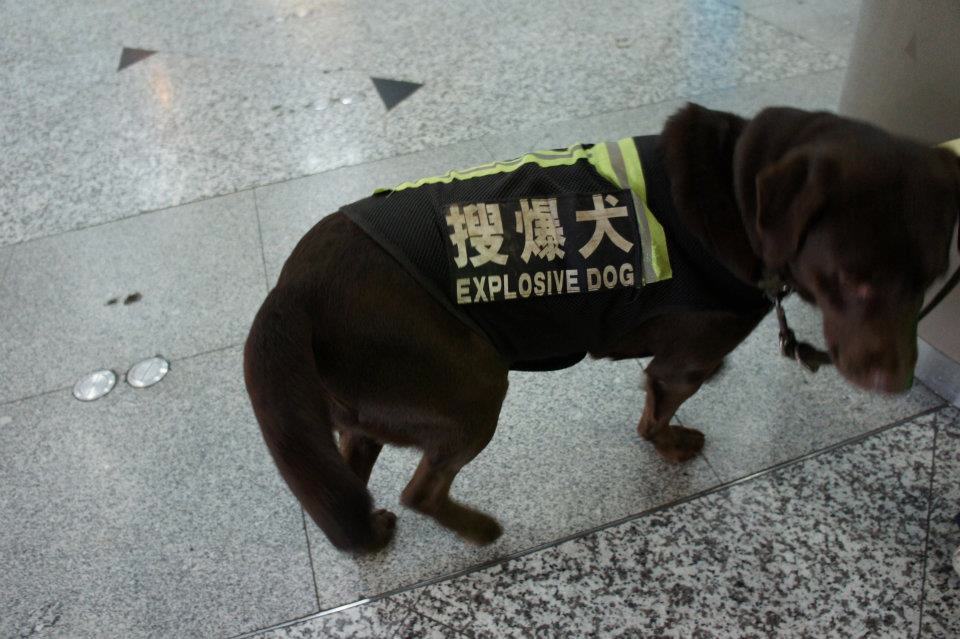
An "explosive dog" is "a dog that is explosive". Translated into Chinese, it'd be 爆发犬 (or 爆發犬 for Traditional Chinese).
The correct English for 搜爆犬 should be "explosives dog" or "explosive detection dog."
Please translate responsibly.
Image credit: Pleated Jeans.
Sunday, April 19, 2015
The Skinny on the Languages in Taiwan
Quick question: what's the official language (written and spoken) in Taiwan?
If you don't know much about this island, chances are your answer would be "Taiwanese."
And you would have guessed wrong.
For the sake of brevity, I won't go into details about the history or politics of Taiwan vs. China. What I'm going to attempt here is to address some general (but totally understandable) misconceptions some people may have about Taiwan, and other trivia on the languages used there.
Please translate responsibly.
If you don't know much about this island, chances are your answer would be "Taiwanese."
And you would have guessed wrong.
For the sake of brevity, I won't go into details about the history or politics of Taiwan vs. China. What I'm going to attempt here is to address some general (but totally understandable) misconceptions some people may have about Taiwan, and other trivia on the languages used there.
- Mandarin is the official language spoken in Taiwan, written in Traditional Chinese characters.
- The "Taiwanese" language in Taiwan refers to a variant of the Fujian dialect. It wasn't until about 10 years ago that the government in Taiwan realized the importance of revitalizing this second-most spoken language on the island. The written form of "Taiwanese" is still in development and therefore not widely applied like the way Cantonese is.
- The third-most spoken language in Taiwan is the Hakka language, which shares some similarities with Cantonese.
- There are a dozen or so indigenous languages in Taiwan spoken by the Taiwanese aborigines. Faced with the danger of extinction, quite a few of these languages are undergoing a revival similar to that of the Taiwanese language, with varying degrees of success in their progresses.
- This has nothing to do with the languages in Taiwan, but is worth mentioning because of the confusion so many have had: Taiwan≠Thailand.
Please translate responsibly.
Monday, March 30, 2015
Traits of a Good Linguistic Professional
After I stepped into the project management side of the translation/localization industry, it came as a mild shock to find that few linguists read instructions and how few are comfortable using the various CAT tools out there. In fact, every time I talk to a project manager within the industry, I get a knowing chuckle when I tell them "this linguist is one of those that actually read all the instructions."
As a linguist, I always want to know how a client thinks of my performance. As a project manager, I get asked quite often by linguists who want to know how well they've done their jobs. Having the advantage of being on both sides of the process, I've decided to share with fellow linguists what their clients look for in a linguistic professional.
This industry, which is not known for compensating its individual contributors handsomely, sure asks a lot of these same contributors. But it does have some rewarding moments. It is my belief, though, that good linguists will shine through and be kept busy by their appreciative clients.
Please translate responsibly.
As a linguist, I always want to know how a client thinks of my performance. As a project manager, I get asked quite often by linguists who want to know how well they've done their jobs. Having the advantage of being on both sides of the process, I've decided to share with fellow linguists what their clients look for in a linguistic professional.
- Always read instructions - The client gives written instructions because it's the only way to ensure everyone is on the same page about what's expected. And of course you should follow the instructions unless you need to...
- Ask questions when instructions don't make sense - As humans, we're known to make mistakes. If something in the instructions doesn't make sense, be sure to ask for clarification.
- Be responsive and flexible - When a linguist is cheerful and accommodating in his/her availability, it invariably opens a lot of doors for future opportunities.
- Have excellent time-management skills - Like I've said before, many things often come down to the wire in this industry. Failing to plan is planning to fail.
- Be unafraid to use new software - A good linguist isn’t afraid to use a new CAT program, digging in on their own to learn how it works; to "boldly go where no one has gone before." I've seen many a good linguist falter when asked to use some software for the very first time. For this group I'd like to offer some encouraging news: CAT tools are made for translators and linguistic professionals, not for software engineers. As such, they are actually very similar and quite user-friendly. If you've used one of them, chances are you will be able to figure out the rest without too much difficulty.
- Know your limits - Most linguistic professionals are eager to please and tend to say Yes to everything. From a growth mindset, this is definitely the way to develop yourself into a well-rounded linguist. However, it is perfectly okay to turn down an assignment if you feel you won't be able to deliver because you don't have enough time or subject matter expertise. Be frank with your client if you have serious reservations about taking on a task. More often than not, the client will thank you for the candor because it gives them time to place the assignment elsewhere.
- Can out-Google the best of 'em - How is your Google-fu? If a rush translation job about an oil transportation contract lands in your lap, do you have the research chops to get up to speed on the subject matter so you can deliver quality work?
This industry, which is not known for compensating its individual contributors handsomely, sure asks a lot of these same contributors. But it does have some rewarding moments. It is my belief, though, that good linguists will shine through and be kept busy by their appreciative clients.
Please translate responsibly.
Sunday, March 8, 2015
Ham Hocks vs. Sexual Harassment
.

A reader sent me this picture and asked, "What does the Chinese say?"
Sitting at home, I burst out laughing. For this case not only shows a lack of understanding of the languages from both the content writer and the translator, but also demonstrates the breakdown of communication between these two key players.
First, let us dissect the Chinese on the placard:
德式 = German style
咸 = salted; salty; cured
猪手 = ham hock(s)
However, in many parts of the Chinese-speaking world, 咸猪手 is slang for "grabby hands." Therefore, whoever decided to name this dish 咸猪手 was either careless or completely unaware of its "grabby hands" annotation. Seeing that the translator didn't raise the red flag that the use of 咸猪手 was questionable, it is very likely that most people in 长沙 (where Quan Sheng Hotel is located) are not familiar with this particular "grabby hands" slang.
It is plausible that the person tasked with translating 德式咸猪手 into English used machine translation such as Google Translate for the job, but didn't bother to check what "German type sexual harassment" actually means in Chinese. For if they had taken the time to do a back translation of "German type sexual harassment" they would've found that this would by no means refer to a dish.
So, how does one say "Cured Ham Hocks" in Chinese? 咸猪脚 and 咸猪蹄 are both fine choices, but definitely not 咸猪手.
And the placard should've read:
Or, if 猪手 absolutely has to be used because that's the way the locals say "ham hocks" in Chinese, then the placard could read:
Please translate responsibly.
Image credit: Imgur

A reader sent me this picture and asked, "What does the Chinese say?"
Sitting at home, I burst out laughing. For this case not only shows a lack of understanding of the languages from both the content writer and the translator, but also demonstrates the breakdown of communication between these two key players.
First, let us dissect the Chinese on the placard:
德式 = German style
咸 = salted; salty; cured
猪手 = ham hock(s)
However, in many parts of the Chinese-speaking world, 咸猪手 is slang for "grabby hands." Therefore, whoever decided to name this dish 咸猪手 was either careless or completely unaware of its "grabby hands" annotation. Seeing that the translator didn't raise the red flag that the use of 咸猪手 was questionable, it is very likely that most people in 长沙 (where Quan Sheng Hotel is located) are not familiar with this particular "grabby hands" slang.
It is plausible that the person tasked with translating 德式咸猪手 into English used machine translation such as Google Translate for the job, but didn't bother to check what "German type sexual harassment" actually means in Chinese. For if they had taken the time to do a back translation of "German type sexual harassment" they would've found that this would by no means refer to a dish.
So, how does one say "Cured Ham Hocks" in Chinese? 咸猪脚 and 咸猪蹄 are both fine choices, but definitely not 咸猪手.
And the placard should've read:
德式咸猪脚
German Style Cured Ham Hocks
Or, if 猪手 absolutely has to be used because that's the way the locals say "ham hocks" in Chinese, then the placard could read:
德式猪手
German Style Ham Hocks
Please translate responsibly.
Image credit: Imgur
Thursday, February 26, 2015
Warning on a Remote Control Helicopter

WARNING
If blade damage,don't be fly. otherwise it will create the human body or blame damage.
The warning above is found on an RC helicopter that our family treated ourselves to for Christmas 2013. I don't know about you, but this is what came to mind when I saw it:
Did they use Google Translate to come up with that?
To test the theory, I used Google Translate to do a back translation of the message and got this:
如果叶片损坏,不要飞。否则会造成人体或怪的伤害。 -- Believe it or not, that's actually close to 100% accurate in terms of what the warning probably would be.
And if we put the Chinese back translation into Google Translate to see what the English would say this time, we get:
If the blade is damaged, do not fly. Otherwise it will cause harm to humans or strange. -- Again, it's almost 100% accurate. So, good news -- they probably didn't use Google Translate!
I'm guessing the Chinese original is something like 如果叶片损坏,不要飞。否则会造成人身或责任伤害。
Which should be translated as: Do not fly the helicopter if a blade is damaged, otherwise bodily injury or property damage may occur.
And here's a message for the manufacturer of a nifty helicopter: 您的直升机翼上面的英文说的是:“如果叶片损坏,别当苍蝇。否则将创造出人体或责怪伤害。”
Please translate responsibly.
Subscribe to:
Posts (Atom)